David Maimon, Tim Forrest and Trevor Anderson
Published
December 2, 2025
Professional athletes live much of their lives in the public eye. From headlines about new contracts and career milestones to news of home purchases or changes in relationship status — nearly everything is visible. Alongside these stories, however, are key personal details that quietly become part of the public record: date of birth, hometown, address, family members’ names, and more. In addition, the images of these athletes are available on every possible social media platform and sport website.
With so much personal information easily accessible, not to mention the very public and financially lucrative contract details, it’s no surprise that established superstar athletes are frequent targets of identity theft attempts. These high-profile athletes know they’re targets. And many have teams, tools, and processes in place to monitor and protect their identities. When their names are used in financial or commercial transactions, organizations tend to apply extra scrutiny to verify that the person on the other end is really who they claim to be.
But what about the up-and-coming athletes — the ones who haven’t made it big yet? Are fraudsters already exploiting their identities to commit identity theft?
Data and Methodology
To address our research questions, we assembled two distinct identity datasets representing different exposure vectors within the online fraud ecosystem:
- NBA Draft Lists for the Years 2020-2024 - We pulled every NBA Draft list published on ESPN between 2020 and 2024, giving us 288 player names.
- NFL Draft Lists for the years 2024 - We then pulled every NFL Draft list published on Wikipedia between 2020 and 2024, giving us 1292 player names.
Once we compiled the finalized list of identities from each data source, we matched them against application records submitted to SentiLink partners since 2020. We looked at our database to see whether these identities were associated with account opening applications that SentiLink has seen across its partner base. These records included both legitimate applications submitted by the actual individuals and suspected identity theft attempts, as flagged by SentiLink’s fraud detection models.
To differentiate between these, we relied on SentiLink’s proprietary risk score, which ranges from 1 to 999. Applications scoring at or above 600 are considered to have a high likelihood of being associated with an identity theft attempt. We assumed that a high SentiLink ID Theft score, which indicates a high risk of identity theft, meant that the identity had been used maliciously and illegally by fraudsters.
Results
Does Making an NBA or NFL Draft List Increase the Risk of Identity Theft Attempt?
To begin our analysis, we used SentiLink’s data to search for account opening applications associated with identities from each of the two lists. We identified 138 identities (out of 288) with application activity from the NBA draft list, and 814 identities with applications (out of 1292) tied to individuals in the NFL draft list.
Next, we measured the prevalence of identities with high-risk applications, signaling a strong likelihood of attempted identity theft within each list. For the NBA Draft list, the identity theft attempt rate was roughly 10% when considering the full roster of identities, and more than 20% when looking only at identities associated with any applications. In comparison, the NFL Draft list showed a similar identity-theft attempt rate of about 10% across all identities, increasing to nearly 15% when focusing solely on identities with applications.
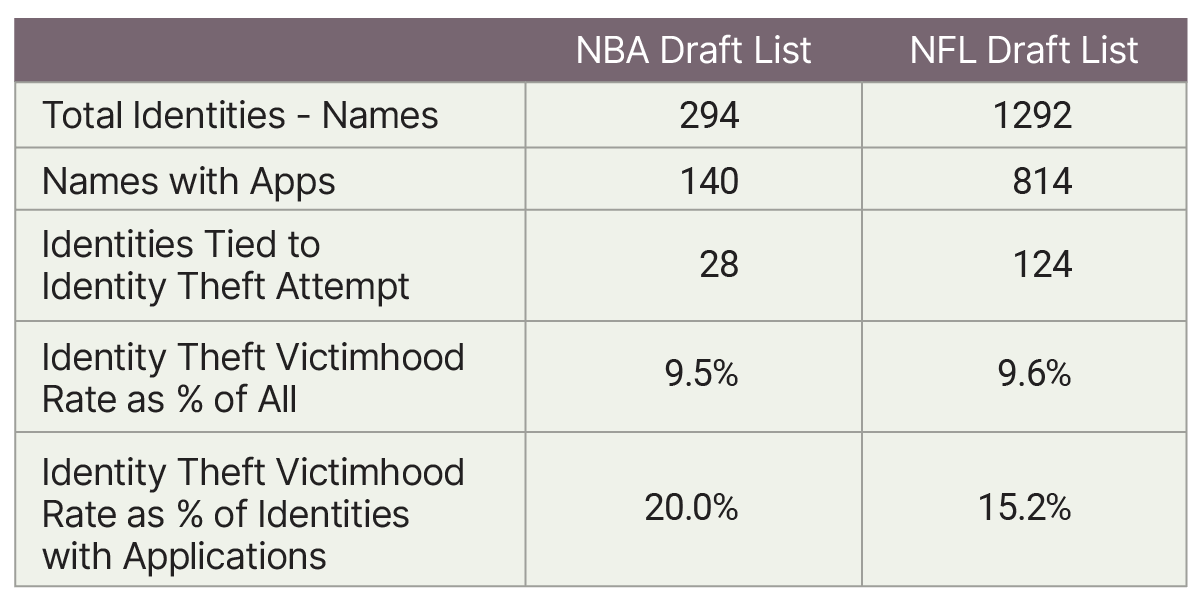
These elevated rates become especially clear when compared with typical identity-theft rates among individuals in the United States. Specifically, our prior research reveals that the baseline identity-theft rates in the context of credit cards, auto loans, and consumer-lending applications, generally fall in the low single digits (2-3%). In contrast, the identity-theft rate for individuals on the NBA and NFL draft lists is roughly five times higher.
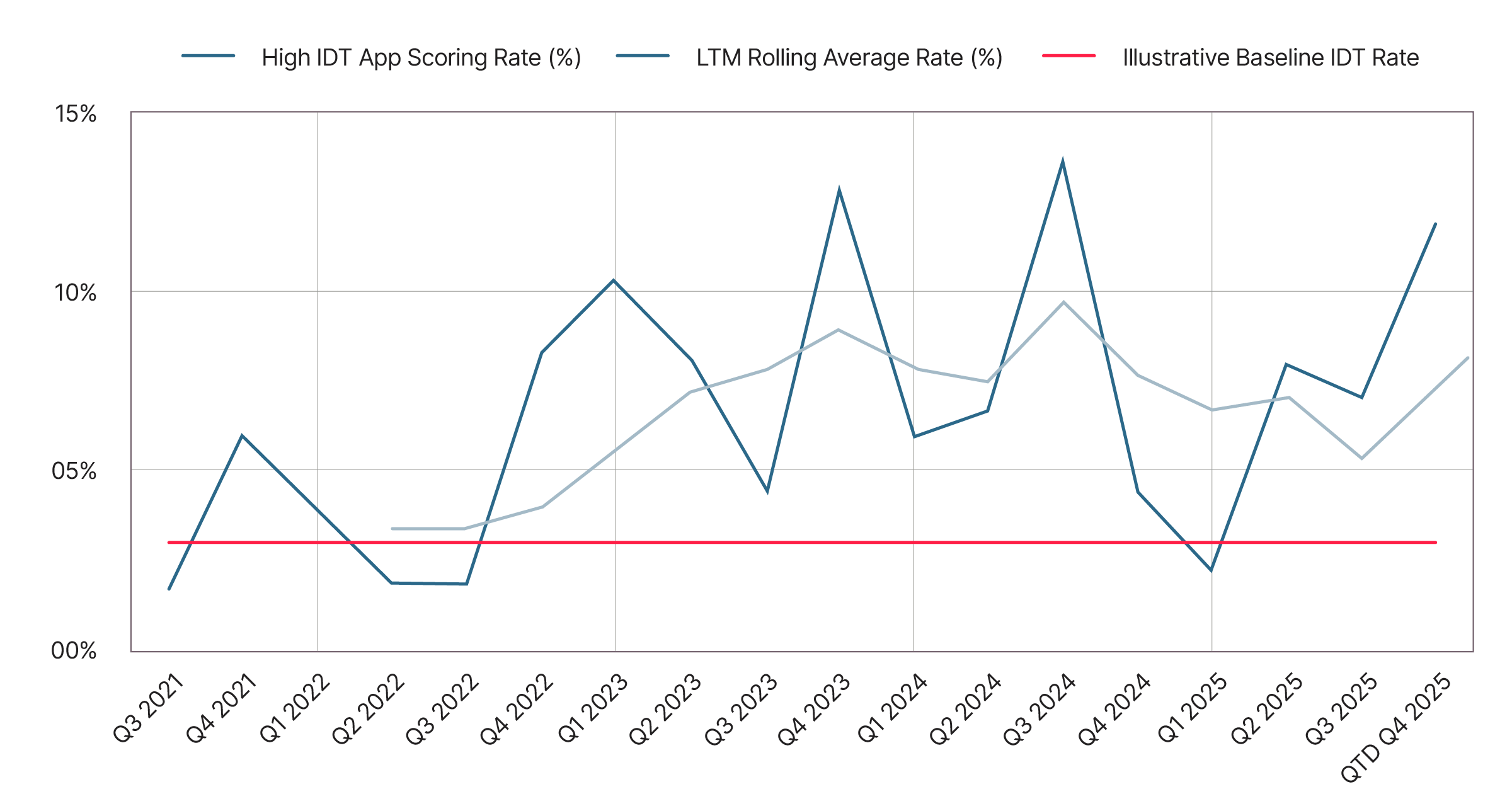
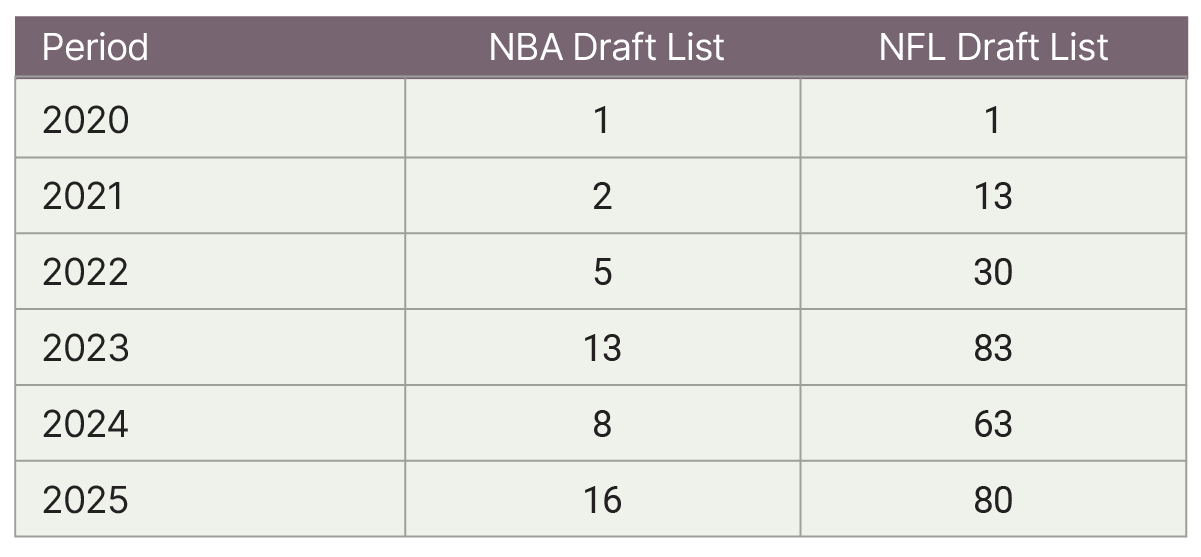
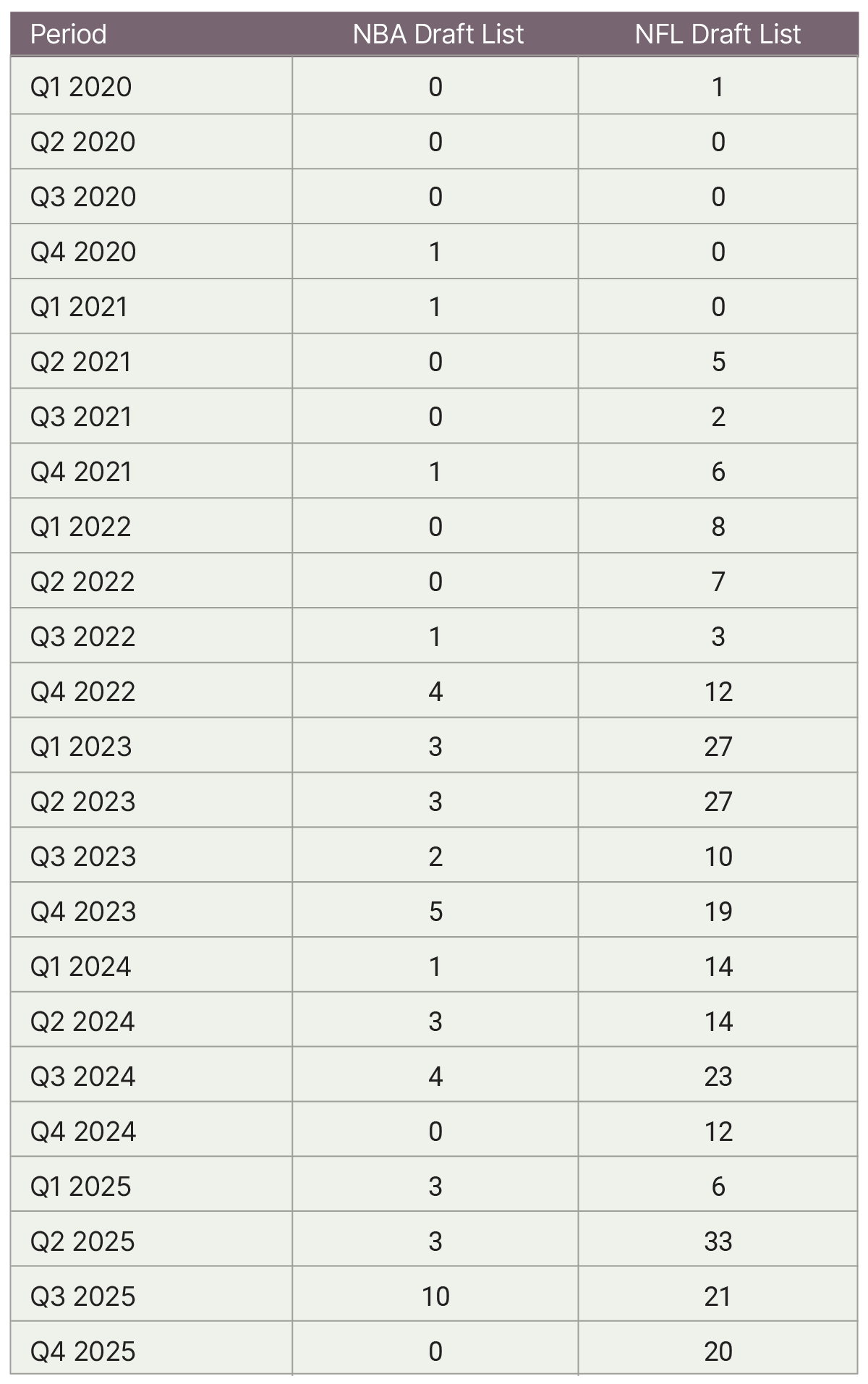
To evaluate whether this pattern has stayed consistent or shifted over time, we charted the quarterly rate of identities with high-risk applications across both lists over the past four years. We also calculated a Last Twelve Months (LTM) rolling average to smooth out short-term volatility. The results show a clear upward trend—and, even when viewed through the rolling average, the rates consistently remain well above the typical baseline identity-theft rate in the low single digits.
High Scoring IDT Application Rates Over Time: Quarterly View (Q3’21 - QTD Q4’25)
Includes NBA and NFL Draft List Identities
Which types of organizations are most commonly targeted by identity thieves using data exposed through different breach vectors?
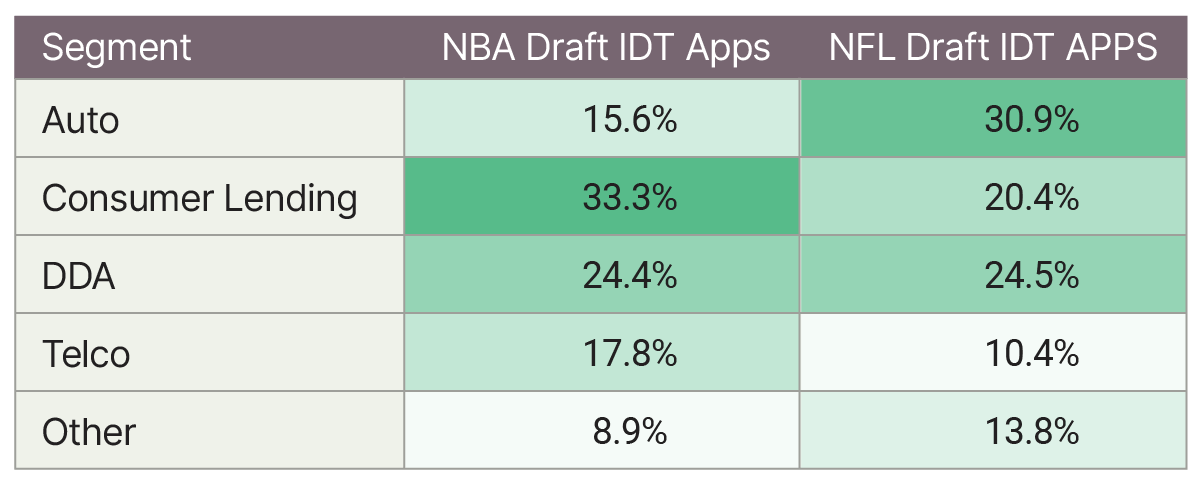
To assess which types of organizations are most commonly targeted by identity thieves who are using identities from the NBA and NFL draft lists, we analyzed the distribution of identity theft (IDT) applications across key financial and service segments. The analysis looked at both absolute distribution and relative likelihood of targeting specific sectors.
Our findings suggest that Consumer Lending and Demand Deposit Accounts (DDA) are the most frequently targeted sectors when identities are sourced from NBA Draft lists, followed by Telecommunication and Auto loan companies. In contrast, Auto loans and Demand Deposit Accounts are the most frequently targeted sectors when identities are sourced from NFL Draft lists, followed by Demand Deposit Accounts (DDA), and Telecommunication companies. This pattern of targeting highlights similar use of the stolen identities across the two sources of identity exposure.
Why is This Happening ?
There are several reasons why identities from NBA and NFL draft lists are disproportionately targeted by identity thieves:
- High Public Exposure and Easy Accessibility- Draft lists are widely published on major platforms—ESPN, Wikipedia, social media, and sports databases. They provide a clean, structured list of full names tied to real individuals. This makes them an easy starting point for fraudsters who need legitimate identities but do not want to purchase stolen data or scrape large datasets. Moreover, athletes projected for the NBA or NFL draft frequently have detailed biographical information—birthdates, hometowns, high schools, colleges—posted online through scouting reports, recruiting sites, and news stories. Even partial biographical details help fraudsters complete applications or pass knowledge-based identity checks.
- Young Adults Are Prime Fraud Targets- Most draft prospects are young adults, typically 18–23 years old. This demographic often has limited credit histories, fewer active financial accounts, and inconsistent digital footprints. These characteristics make them ideal targets because fraudulent applications are less likely to trigger alerts associated with established credit behavior, and there is often less public information available to contradict a fraudulent application.
- Low Likelihood of Victims Noticing Fraud Quickly- College athletes and draft prospects often move frequently (campus → training facility → combine → draft events → pro team) and may not be actively monitoring their credit reports or mail. This gives fraudsters more time to operate before their activity is detected.
- Perceived “High-Value” Identity Association- Fraudsters also assume that identities associated with prominent institutions (NCAA athletics, professional sports pipelines) may pass risk checks more easily. Even though the athletes themselves may not have high income yet, the perception of legitimacy and stability can reduce scrutiny in automated underwriting systems.
- Use of AI Tools to Manipulate Public Athlete Images- A growing driver of exploitation involving NBA and NFL draft prospects is the easy availability of AI tools capable of manipulating publicly accessible athlete photos. These tools allow criminals to alter official images so that athletes appear to be holding driver’s licenses or other forms of identification. Tools can even animate static photos to give the perception of "liveness," which can help defeat some identity authentication tools.
Conclusion
The story here is clear: identity thieves aren’t waiting for athletes to become stars before exploiting their personal information. Draft prospects—young, highly visible, and digitally exposed—are becoming targets long before they ever play a professional game. Their public profiles offer fraudsters everything they need, from birthdates and hometowns to high-quality images that can be manipulated with AI into realistic verification selfies.
The upward trend in high-risk applications across recent draft classes shows that this is not a one-off anomaly but a growing fraud pattern. As more athlete data moves online, the barrier for criminals to impersonate them continues to shrink. Financial institutions, platforms, and verification providers will need to adjust accordingly—because the fraudsters already have.
As published by NBC News.
Appendix A. Fraudulent Application Activity Observed Against Identities Released on NBA and NFL Draft Lists (2020-2025)
Subscribe
Share


Related Content


.png)