SentiLink
Published
November 3, 2026

- About 72% of identity fraud losses come from applications SentiLink flags as high-risk for first-party fraud, per 2026 retrostudies.
- First-party fraud risk signals are scattered across applications to many institutions and industries, so no single lender can see them.
- Consortiums help, but they’re limited by inconsistent labels, label quality, slow performance-based data, sharing with competitors, and single-industry coverage.
Fraud and Risk teams are concerned about first-party fraud. And with good reason: the burgeoning "credit repair" ecosystem is empowering fraudsters with new tools for executing first-party fraud techniques like credit washing at scale, and 2026 SentiLink retrostudies have found that about 72% of identity fraud losses come from applications that we flag as high-risk for first-party fraud.
So why is so much first-party fraud making it past fraud checks?
The risk signals you can't see
The main thing that makes first-party fraud so easy to miss at onboarding is that it typically manifests in historical and behavioral signals no single institution can see, as they're amassed in activities across a number of institutions or across industries.
To illustrate this, let's take a look at a real case study (we have censored the names and changed some details in the images below, but this reflects a real and fairly typical first-party fraud case):
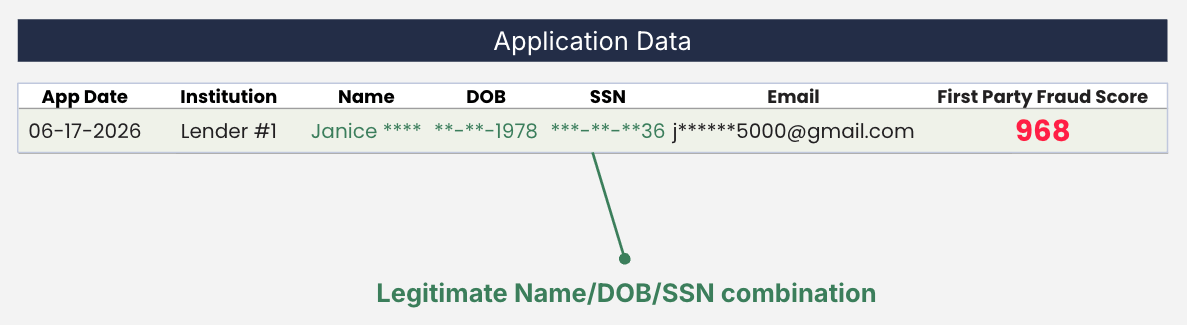
This application scores as “very high risk” for first-party fraud. But why? From the information provided on the application, Lender #1 doesn't have much reason to doubt this application; it contains a legitimate core identity and no other obvious signs of fraud.
It is the applications to other institutions prior to the above application that tell a riskier-looking story:
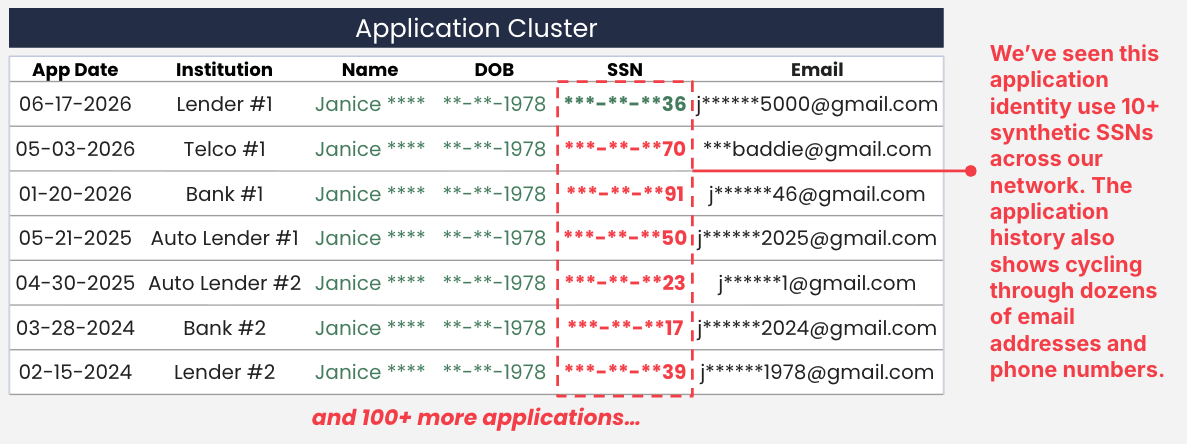
While the application to Lender #1 is not synthetic fraud, we can see that this identity has been associated with a variety of synthetic SSNs in the past. This is a major risk signal for first-party fraud, but it's not one that Lender #1 could see — all of these applications are to other institutions, and as we can see above, many of them are applications to institutions in other industries.
In short: individual institutions simply can't see a broad enough picture for most first-party fraud risk to be visible. That makes accurately flagging risk at application virtually impossible.
Why consortiums fall short
One common way to address this shortcoming is consortiums. Sharing data can give institutions a broader view and allow them to catch some risky applications that might otherwise go through. But the consortium approach also has a lot of shortcomings, including:
-
Consistency — Different institutions define and label first-party fraud differently, which makes it difficult to derive maximum value from shared labels.
- Quality — When using labels from other institutions, you're at the mercy of their fraud team's skill at labeling. Even when label definitions align across institutions, it is not uncommon for fraud, especially first-party fraud, to be mislabeled.
- Latency — Consortium data-sharing is based on performance data, which means a fraudster needs to apply, use the account, default or bust out, and then have the institution to which they applied label that account as risk and share that label before anyone else in the consortium sees any indication of risk. That process can take months or years, during which time you may receive and approve an application from the same fraudster.
- Competition — Consortiums require sharing performance data with other institutions, which often includes direct competitors in the same industry.
- Coverage — Consortiums are often organized around specific industries, meaning that member institutions are still mostly or entirely blind to any risk signals from outside that industry.
SentiLink's First-Party Fraud score addresses all of these issues. It is built around a consistent identity fraud and first-party fraud taxonomy, labels are quality-assured by our Fraud Intelligence Team, it's built on application-level signals to eliminate the need to wait for performance data before flagging risk, and it gives you access to intelligence from our cross-industry network of 500+ partners without having to share any data with competitors.
Learn more
Our whitepaper, Real Identities, Real Losses: Reducing First-Party Fraud, goes deeper into the problem. It covers SentiLink’s definition of first-party fraud, the identity-level signals our First Party Fraud Score evaluates, and recommended step-up treatments for high-risk applications.
It also includes results from recent retrostudies so you can see how much first-party fraud is likely already on your books.
Subscribe
Share


Related Content