Burt Helm
Published
April 1, 2026
Last month, the House Education Committee voted 30-3 to require fraud screening on every application for federal student aid. The bill, the No Aid for Ghost Students Act of 2026, was one of three student aid fraud bills that passed committee the same day and is now headed to the full House. Here’s a closer look at the fraud they’re responding to — known in underground markets as “Pell Running” — which SentiLink’s Head of Fraud Insights, Dr. David Maimon, has been investigating, detailed in the most recent SentiLink Fraud Report.
How it works
A fraudster acquires a stolen or synthetic identity, uses it to enroll at a college, and files a Free Application for Federal Student Aid (FAFSA). Once the aid is approved, the disbursement — up to $7,400 — flows out as a living-expense payment. The fraudster collects it and disappears, never having attended a class. Community colleges are a common target because their low or waived tuition means more of the federal money comes out as cash to the student rather than going to the school.
An old scheme, a new opening
Federal investigators have been chasing student aid fraud for decades — but the pandemic changed the math. "When the pandemic hit, everybody went to online learning," Jason Williams, the Department of Education's assistant inspector general for investigations, told ABC News in January. "It really did open the door." His office currently has more than 200 open cases. In 2024, according to the report, nearly a third of all community college applicants were identified as fraudulent.
For individual institutions, the costs are both administrative and financial. Fraudulent applications overload staff and take seats away from legitimate students — in a 2024 case, the Foothill-De Anza Community College District received roughly 26,000 applications in a single year, of which about 10,000 were flagged for possible fraud. In some cases, institutions face financial clawbacks. The College of Southern Nevada reported that it was required to repay $7.43 million to the federal government after fraudulent enrollments in a single semester.
Fraud as a service
Pell running has matured to the point where a supporting service industry has grown up around it. Stolen identity packages tailored for FAFSA applications — known as "Fullz" — are openly advertised on Telegram, sometimes bundled with fabricated high school transcripts. Step-by-step tutorials sell for up to $300. Specialized cash-out services convert disbursements into usable funds. Vendors offer customer reviews and promotional discounts.

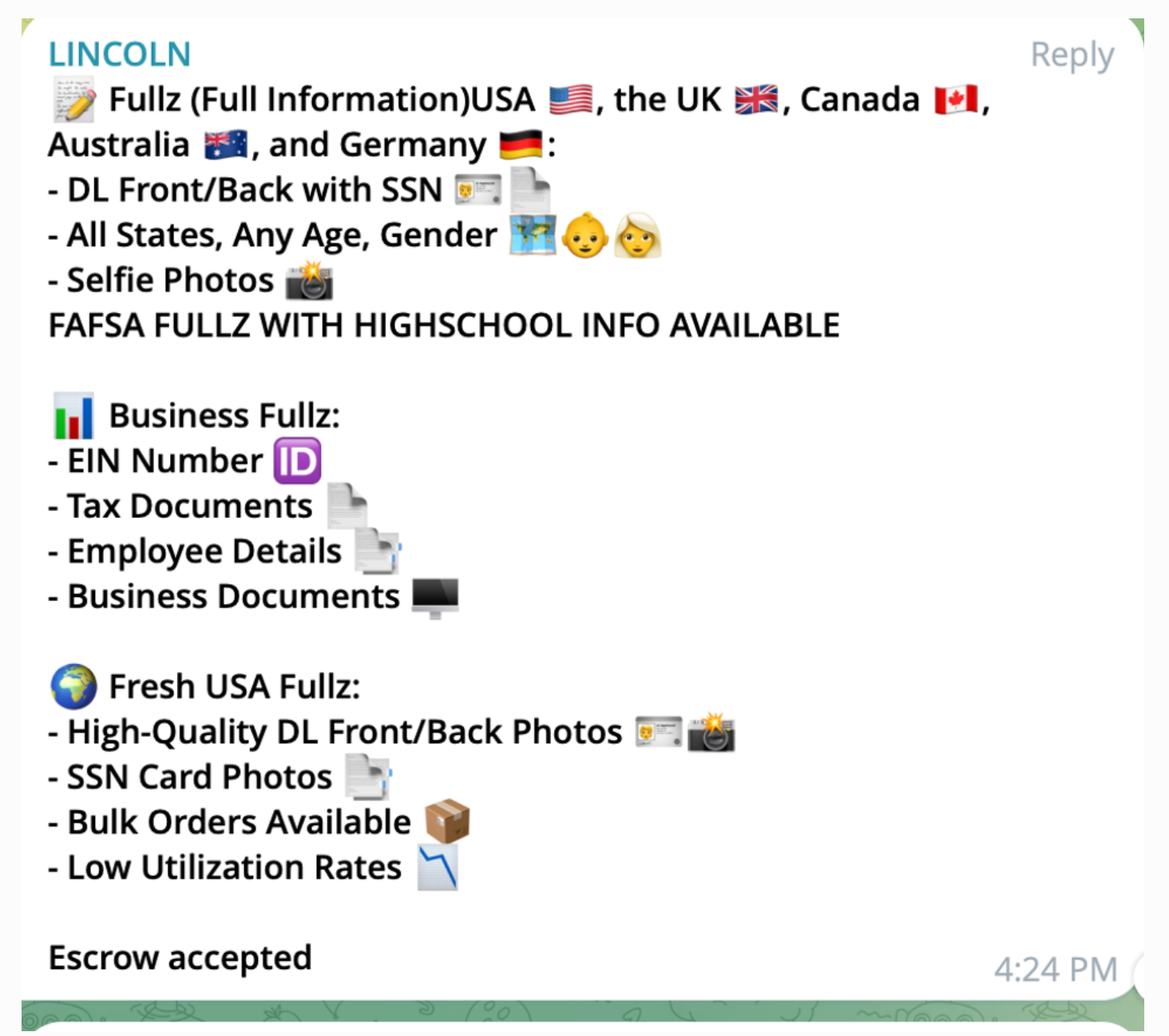
Stolen identity packages advertised openly on Telegram, tailored for FAFSA fraud.
As Congress seeks to add new safety measures — like live video verification, a step-up measure detailed in the pending legislation — fraudsters are finding new ways to circumvent them. As we documented in our 1H 2025 Fraud Report, fraudsters are already using AI-generated video to defeat liveness checks, and deepfakes continue to get cheaper and better.
What comes next
The three bills now head to the full House. Whatever Congress does, fraud will keep evolving — as it always has. Institutions would do well to stay ahead of new methods and trends rather than wait for Washington to catch up. Pell running is one of five fraud trends Dr. Maimon and the SentiLink team examined in our 2H 2025 Fraud Report, which draws on analysis of more than 236 million account-opening applications from the second half of 2025.
Subscribe
Share



.png)