David Maimon
Published
June 1, 2026
For most of modern history, verifying someone's identity was a straightforward, if imperfect, process. A government-issued document such as a driver's license, a Social Security card or a passport, and a physical presence were enough. You showed your face, you showed your papers, and that was sufficient.
The driver's license became the default answer to "can you prove who you are?" at banks, bars, pharmacies, and government offices alike, not because it was designed for that but because it was there. It carried a photo, a name, a date of birth, and a government signature, which was enough. Passports served the same function at a higher tier of trust. Where a license confirmed identity domestically, a passport confirmed it internationally, and the bar for obtaining one was higher, which made it more valuable as a verification instrument.
By the latter half of the 20th century, both documents along with social security cards had been folded into the formal verification infrastructure of financial institutions, border agencies, and private businesses. They became the foundation of what identity verification meant in practice: a laminated card or a booklet, issued by a state, accepted as proof. The system worked because the documents were hard to fake, the interaction was in-person, and the institutions doing the checking were operating in a world where the tools available to fraudsters were limited by the same physical constraints they relied on.
The shift to digital changed the equation entirely. As financial services, telecommunications, and government agencies moved their onboarding processes online, physical presence disappeared from the verification chain. Institutions that once required a customer to show up in person with documents in hand now had to replicate that process through a screen. The solution the industry landed on was a combination of document uploads, selfies, and liveness checks, asking users to photograph their ID, photograph their face, and prove in real time that the face was attached to a living person. It was also a system that introduced new attack surfaces at every step, and a sophisticated underground market for fraudulent identity documents grew up to exploit them.
The evolution of the online fake document economy
The online underground market for forged documents did not appear overnight, and it did not stay static. It evolved in distinct phases, each shaped by the tools available, the platforms that hosted it, and the countermeasures it was designed to outrun. From the darkweb market vendor stalls of the early 2010s to the AI-powered, no-technical-skills-required pipelines operating today, the supply chain for fraudulent identity documents has undergone four recognizable transformations. Each era is worth examining on its own terms.
The Evolution of the Online Supply Chain for Fraudulent Identity Documents
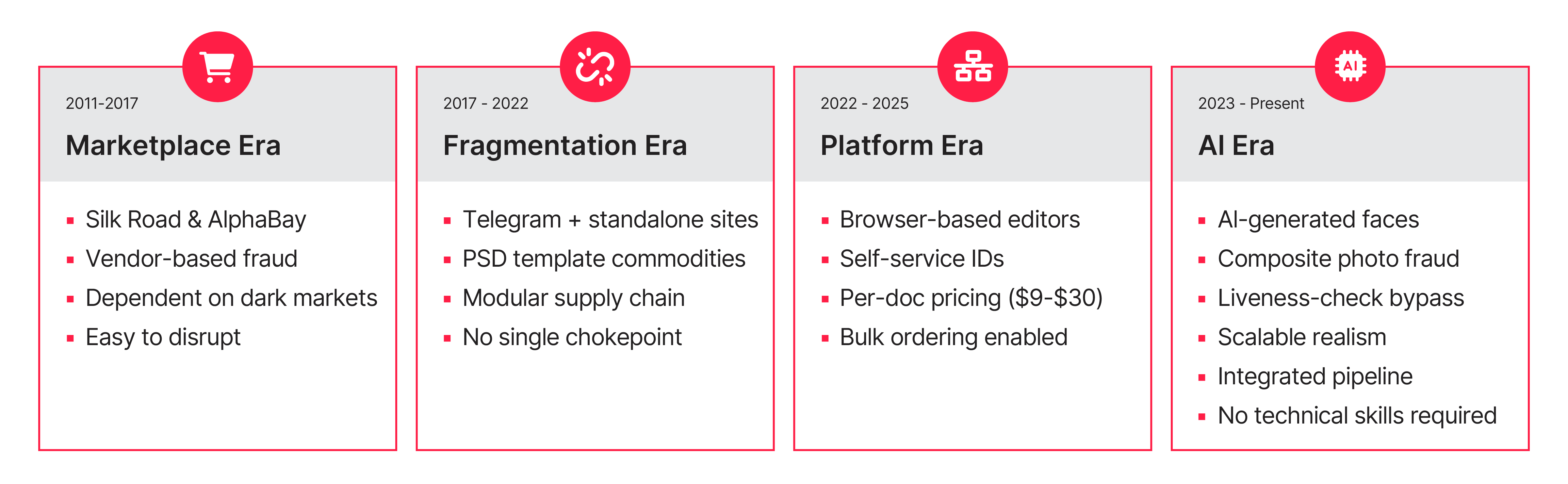
Marketplace Era (2011–2017)
The first recognizable online market for fraudulent identity documents was Silk Road. Launched in 2011 and shut down by the FBI in 2013, Silk Road was best known as a drug marketplace, but it was also where forged documents first found a commercial home online. Vendors listed physical driver's licenses, passports, and social security cards alongside narcotics, and buyers purchased them the same way, through a pseudonymous storefront, paid in Bitcoin, delivered by mail. The model was simple: order a fake Oregon license the way you'd order anything else, and wait for it to show up in your mailbox.
Silk Road's takedown in 2013 didn't kill the market. It proved there was one. Silk Road 2 launched within weeks of the original's closure, and AlphaBay, which went live in 2014, became the largest dark net marketplace of its era before being seized by law enforcement in 2017. Document fraud scaled with them. The commodity set remained largely the same throughout this period: physical reproductions of state-issued driver's licenses, passports, and social security cards, manufactured somewhere, packaged, and shipped through the postal system to buyers who had never met the vendor in person and never would.
What defined this era structurally was centralization. These were vendor marketplaces, hosted on the darknet, with administrators, reputation systems, escrow, and customer reviews. That architecture made them functional, but it also made them fragile. A single law enforcement operation aimed at the platform could take down every vendor on it simultaneously.
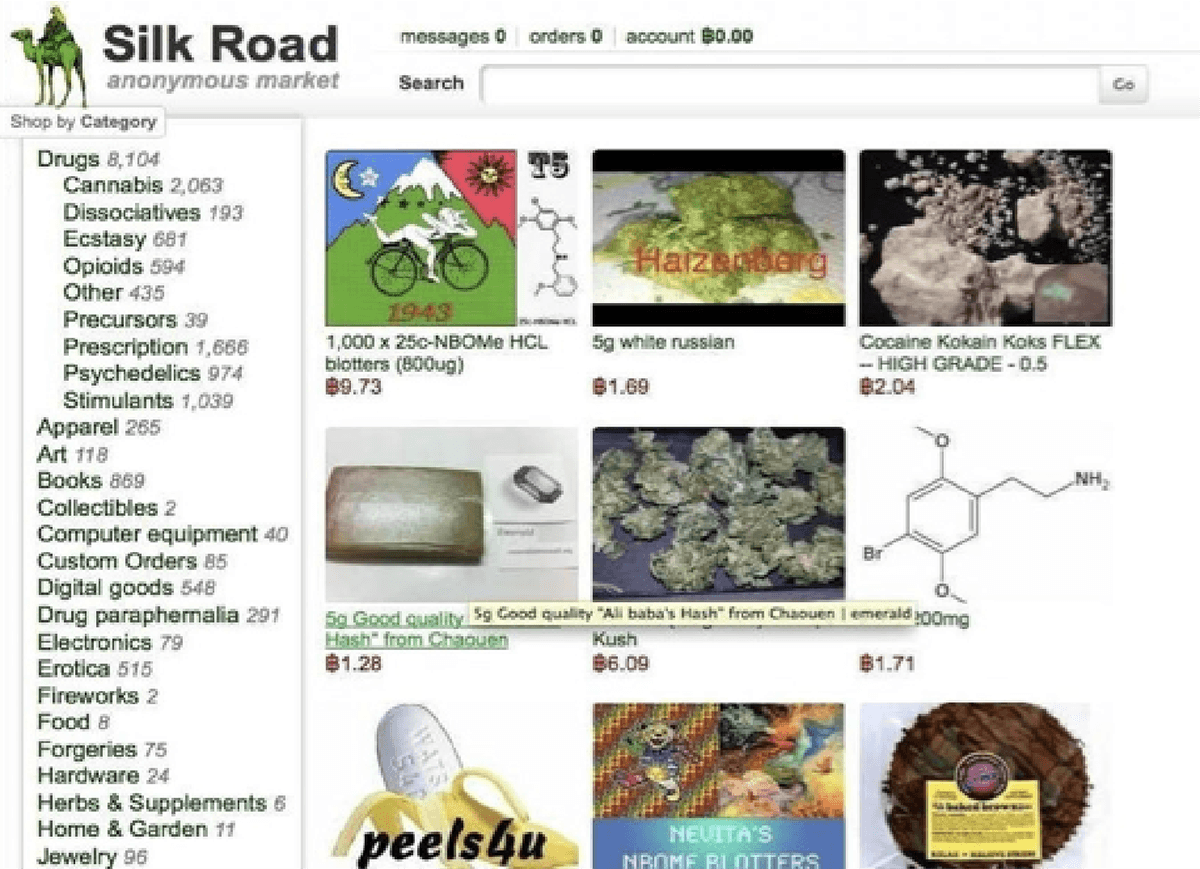
Screenshot of Silk Road market interface. Fake documents were sold under the "Digital goods" and "Forgeries" tabs.
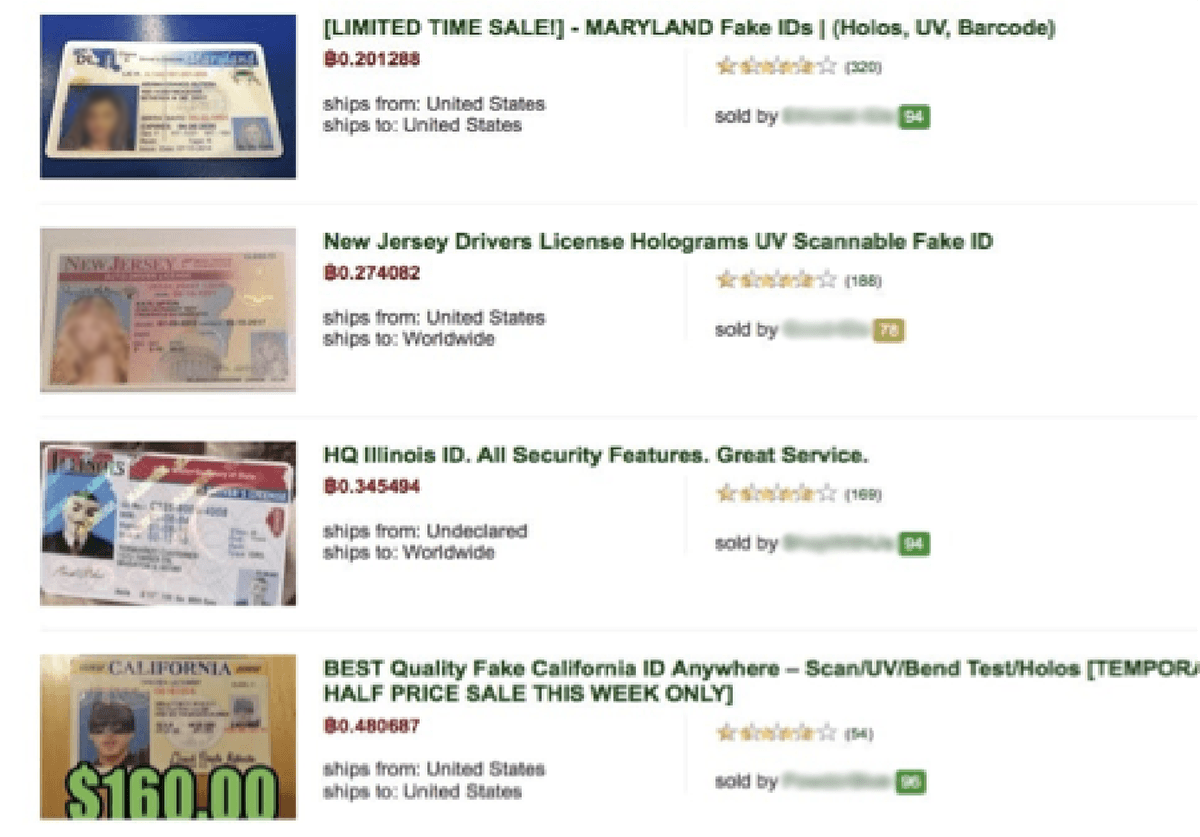
Screenshot of driver's licenses sold over Silk Road
Fragmentation Era (2017–2022)
The demand side of the market shifted around 2015, when banks and financial institutions began rolling out digital onboarding. Document uploads, selfie matching, and liveness checks replaced the branch visit, and with that shift came a new type of customer for fraudulent documents. It was no longer just someone who needed a fake ID to get into a bar. It was someone who needed a document that could pass a remote verification system. The market responded accordingly.
Vendors who had operated under the umbrella of centralized dark net marketplaces began setting up independently. Standalone shops appeared on the darknet, on Telegram channels, and on the clearnet, sometimes with remarkably little attempt at concealment. The product offering evolved alongside the distribution model. Physical forgeries were still available — driver's licenses, passports, and social security cards shipped to a mailbox — but the catalog expanded significantly to meet digital demand. Vendors began selling Photoshop templates for driver's licenses covering all fifty U.S. states and dozens of countries, along with passport and social security card templates, priced as low as $22. A buyer with a template and basic image editing skills could produce a document themselves, without waiting for a physical shipment or trusting a vendor with a delivery address.
Payment options broadened to match the customer base. Crypto remained the default for anonymity-conscious buyers, but vendors also accepted wire transfers, PayPal, and gift cards, lowering the friction for less technically-sophisticated customers. Customer service followed. Automated bots handled order intake and status updates on Telegram. Some vendors offered revision guarantees and replacement policies. The infrastructure of a legitimate e-commerce operation had been grafted onto an illegal one, and it worked.
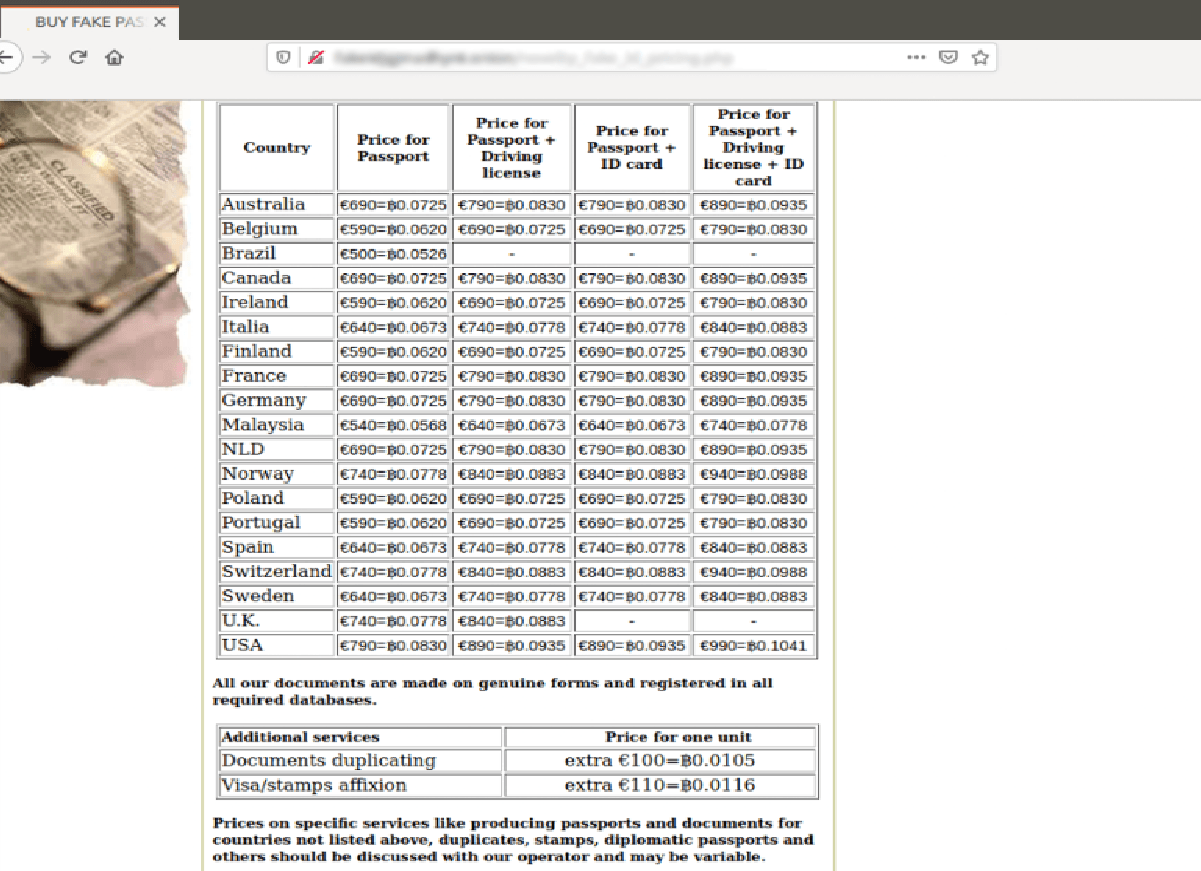 Darknet shop for the sale of fake passports
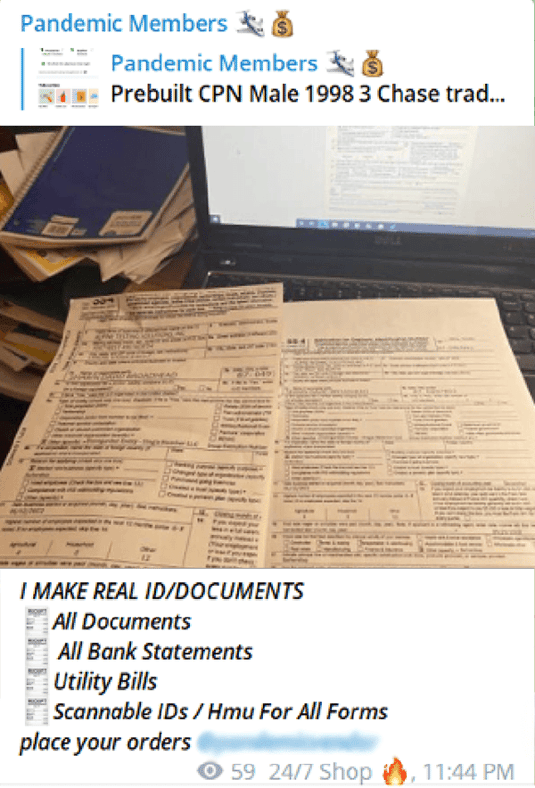
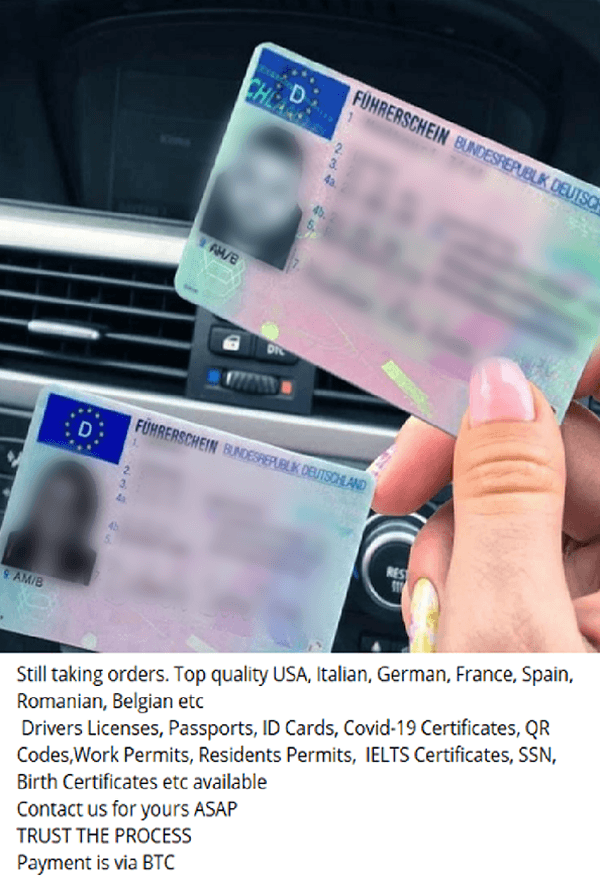
Telegram shops for the sale of fake documents
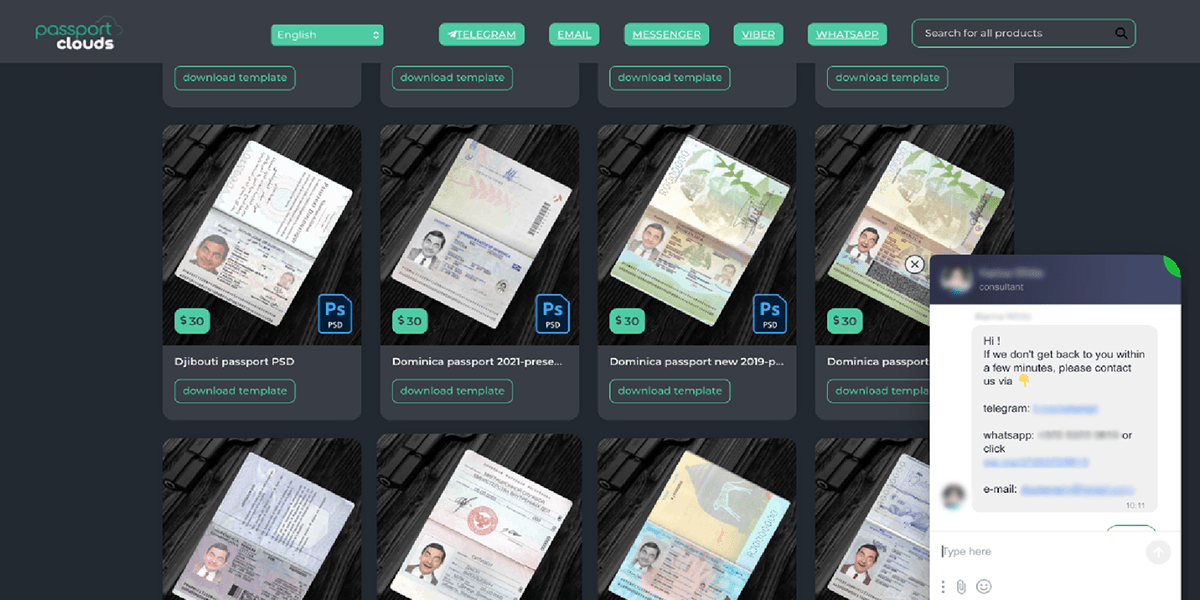
Clearnet shop for the sale of fake documents
Platform Era (2022–2025)
The Fragmentation Era had democratized access to fraudulent documents. The Platform Era industrialized it. The template model still required a buyer to own Photoshop, know how to use it, and invest time in producing something passable. The next generation of services removed even that barrier.
Browser-based self-service generators began emerging around 2021, in the middle of the pandemic, precisely when remote identity verification had become the norm and demand for convincing digital documents was at its highest. Verifi.tools and OnlyFake were among the earliest and most prominent. The model they introduced was straightforward to the point of being mundane. A user navigated to a website, uploaded a photo, entered a name, a date of birth, an address, and whatever other fields the target document required, selected a state or country, paid somewhere between nine and thirty dollars, and received a finished document. No Photoshop. No technical knowledge. No vendor relationship to manage. The entire interaction took minutes.
The documents that came out the other side were not crude forgeries. They were clean, templated, consistently formatted outputs designed to survive the kind of automated document review that financial institutions and online platforms were running at scale. Per-document pricing made bulk ordering economically viable for fraud operations that needed volume. The production cost of a fake identity had dropped to the price of a fast food meal.
What the Platform Era represented, structurally, was the completion of a transition that had been underway since the Fragmentation Era: the removal of every meaningful barrier between a bad actor and a convincing fraudulent document. The skill requirement was gone. The vendor dependency was gone. The wait time was gone. What remained was a checkout flow.
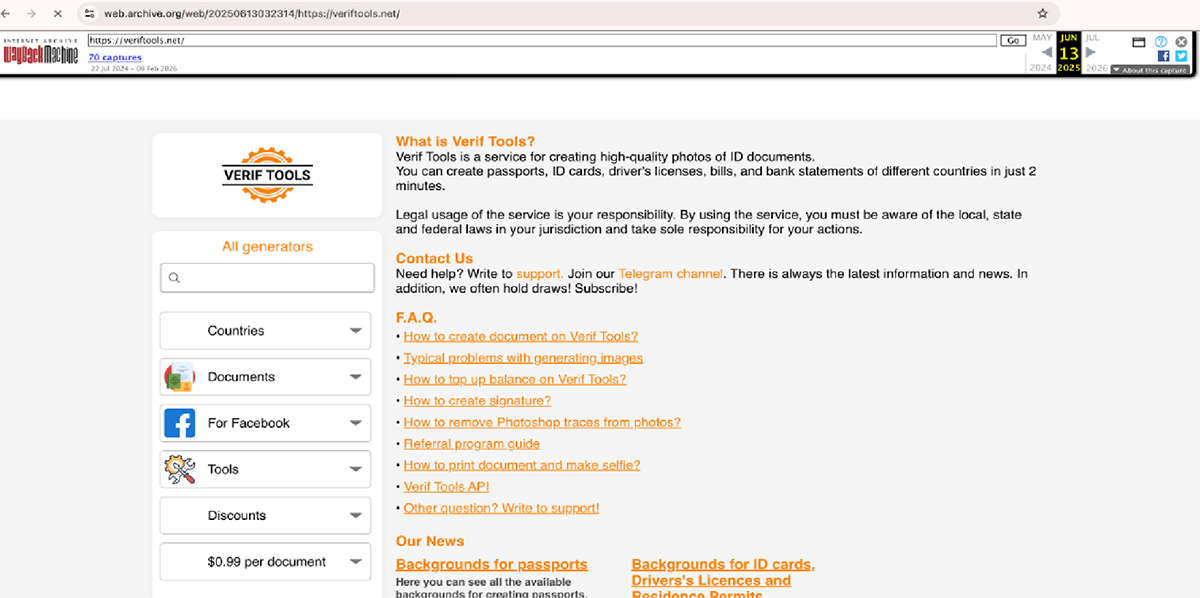 Screenshot of Verif Tools, a platform for the creation of fake driver's licenses and passports
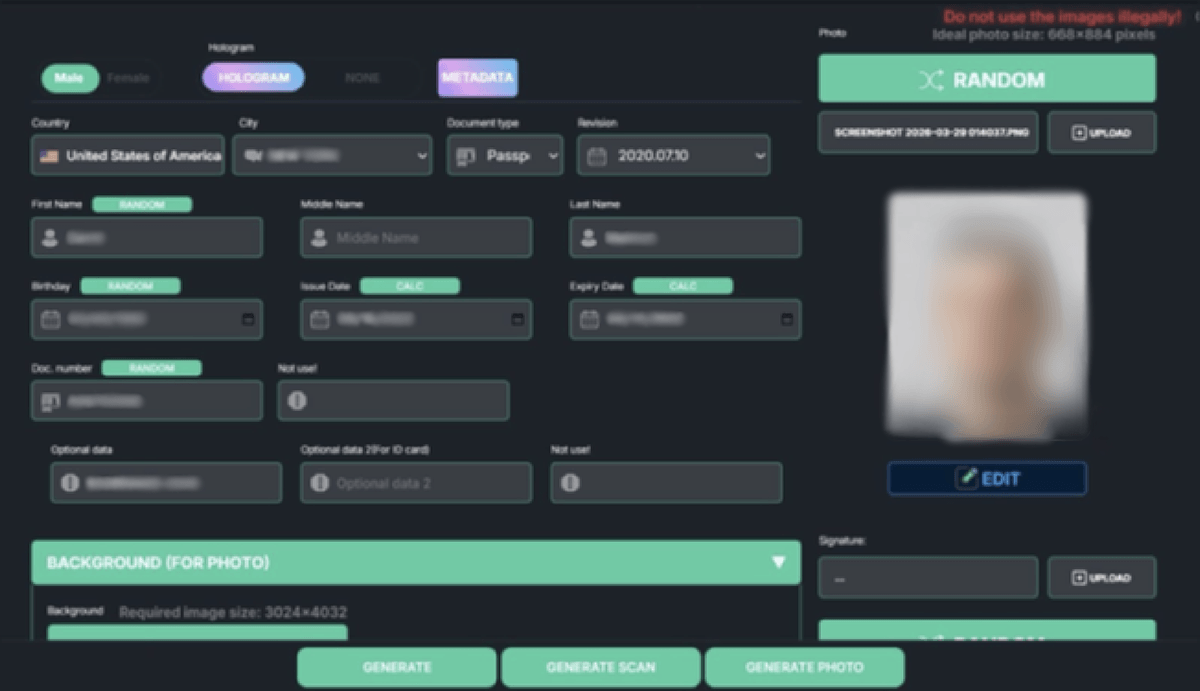
Screenshot of OnlyFake, a platform for the creation of fake driver's licenses and passports
AI era (2023–Present)
The only document bottleneck that survived the Platform Era was the photo. A self-service generator could format a driver's license perfectly, but the image on it still had to come from somewhere, and a mismatched or low-quality photo was the most reliable signal that something was wrong. Generative AI solved that problem directly, removing that final bottleneck.
AI face generation tools now produce synthetic portraits that are, to the human eye and to most automated review systems, indistinguishable from real photographs. A fraudster no longer needs a cooperating real person, a stolen photo, or a carefully staged selfie. They generate a face, feed it into a document generator, and receive a finished identity. The two tools, face generation and document production, have increasingly been packaged together into fully integrated fraud pipelines that handle the entire workflow in a single interface. No technical skill required at any step.
The more significant development, though, is what AI has done to liveness checks. The verification layer that financial institutions added specifically to defeat static document fraud, the requirement that a real human face appear on camera in real time, can now be bypassed. AI tools can animate a synthetic face, producing video output convincing enough to pass liveness detection systems. A face that was never attached to a living person can blink, turn, and nod its way through an onboarding check. The last friction point in the remote verification chain has been compromised, and the pipeline from fraudulent identity to verified account is, for the first time, fully automated from end to end.

AI-generated passport image of fabricated identity, produced using ChatGPT
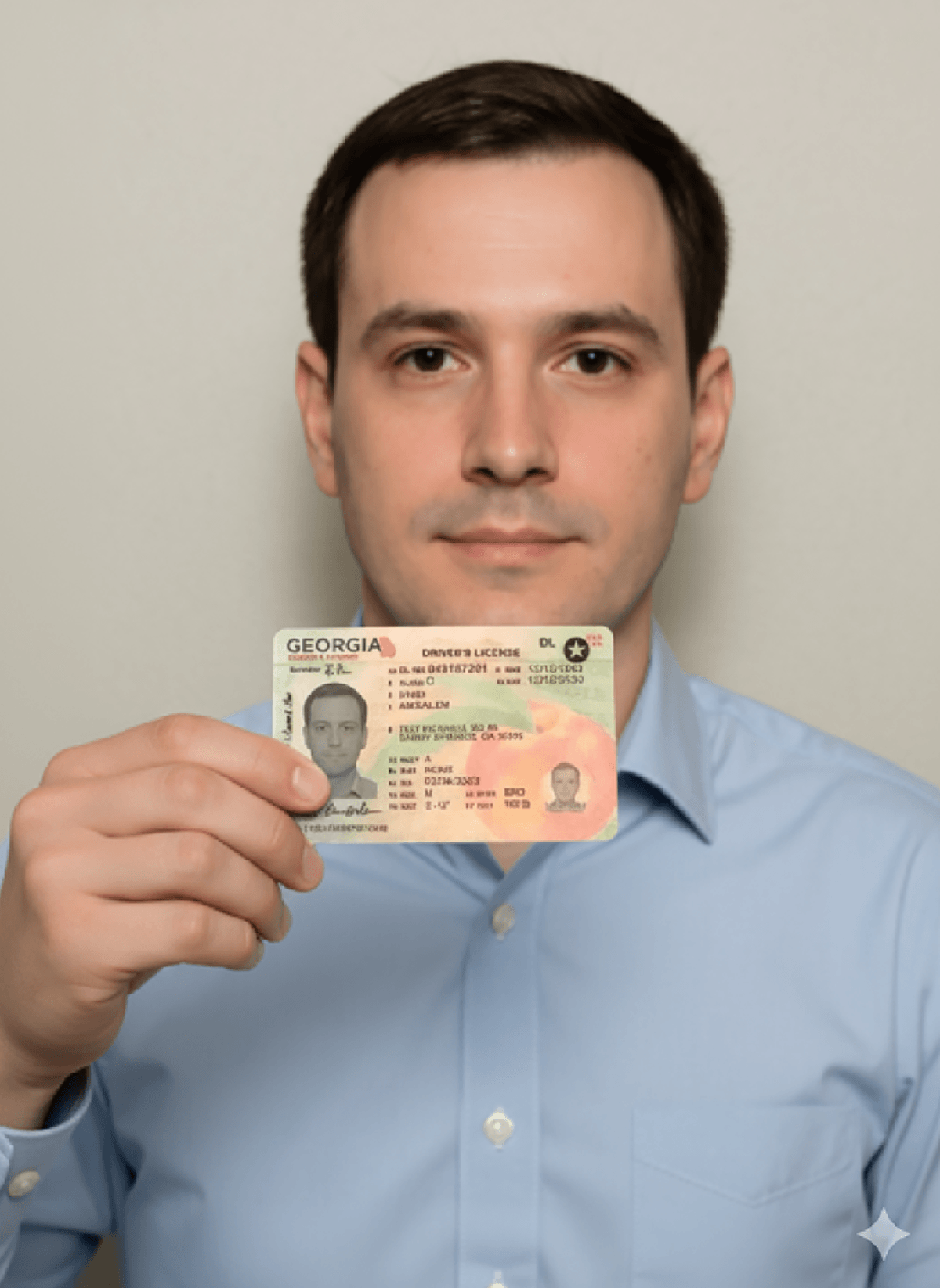
AI-generated verification image generated by Kling AI
The human cost: identity theft trends across each era
FTC data on consumer identity theft reports in the USA tracks closely with the evolution of the supply chain described above, and helps illustrate the real-world impact of each era. As shown in the graph below, reports grew steadily through the Marketplace Era, from roughly 370,000 in 2012 to just under 400,000 by 2017, reflecting a market that was active but constrained by its own infrastructure. The Fragmentation Era changed the trajectory dramatically. As vendors dispersed across Telegram and standalone sites and digital documents entered the product catalog, reports nearly doubled, climbing to 1.4 million by 2020. The Platform Era, which coincided with the timing of COVID, pushed the numbers to their peak, 1.43 million in 2021, before a modest pullback in 2022 and 2023. The AI Era, still in its early stages, shows reports beginning to climb again.
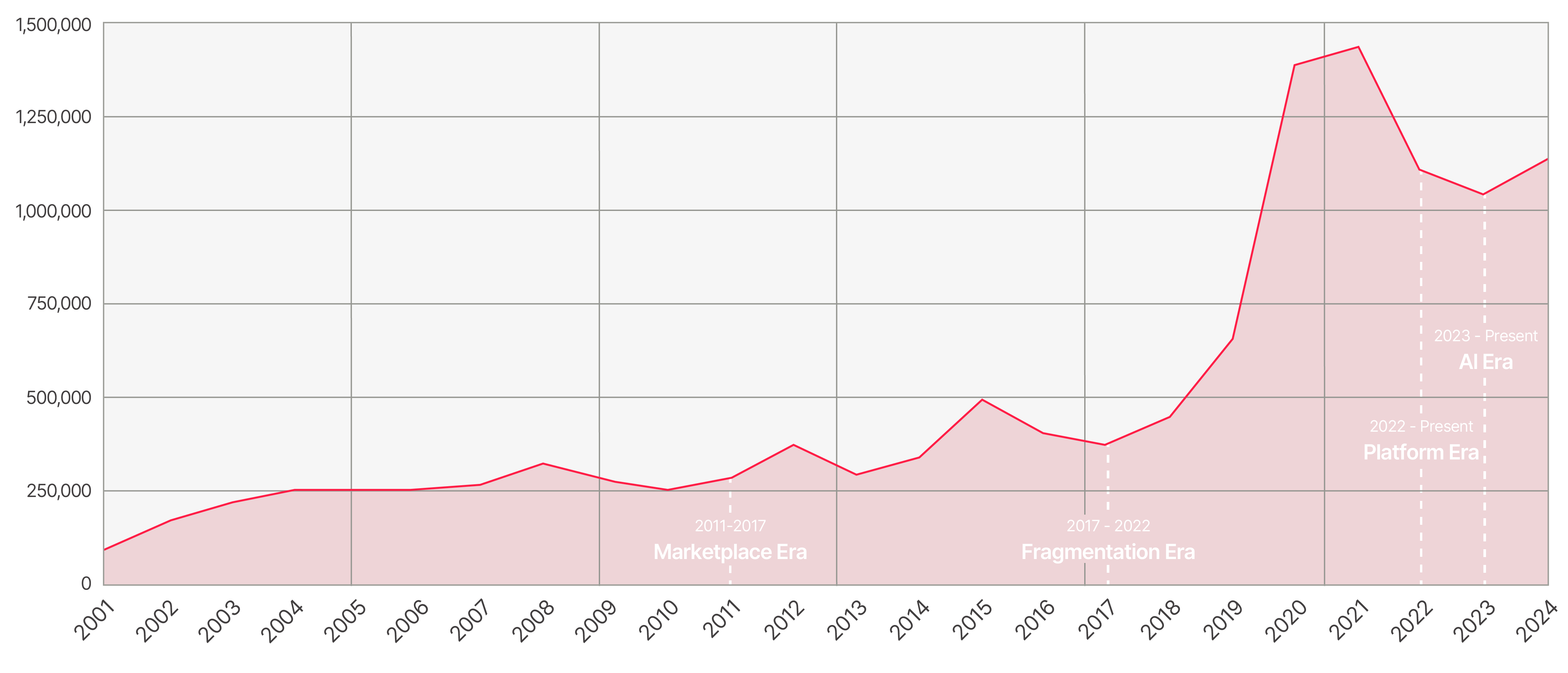
The supply chain has evolved. The response has not.
The evolution of the online supply chain for fraudulent identity documents is, at its core, a story about friction. Every era in this timeline represents a reduction in the effort, skill, and resources required to produce a convincing fake identity. What began as a niche offering on a darknet drug market, dependent on physical manufacturing and postal delivery, has become a fully automated, AI-powered pipeline accessible to anyone with a browser and ten dollars. The barriers did not erode gradually. They collapsed in steps, each triggered by a combination of new technology, new demand, and the failure of existing countermeasures to keep pace.
This does not mean identity verification is impossible. It means the industry needs to shift its trust model away from static artifacts and toward signals that are substantially harder to manufacture artificially: history, consistency, and authority. SentiLink's models are based on these signals.
A fake document can be generated in seconds. A synthetic face can be rendered instantly. But deep historical relationships across financial institutions, long-term behavioral consistency, device reputation, authoritative data sources, and cross-network identity intelligence remain significantly harder to fabricate at scale. Fraud prevention strategies built around these signals are more resilient precisely because they rely less on what a person presents in a single onboarding session and more on whether the broader identity story makes sense over time.
That shift is already becoming necessary. As AI continues to erode the reliability of document-based verification, financial institutions will increasingly need fraud defenses capable of looking beyond the uploaded credential itself and into the historical and authoritative context surrounding the identity. The future of identity trust will depend less on whether a document appears authentic and more on whether the identity behind it demonstrates the depth, continuity, and corroboration that synthetic fraud struggles to replicate.
Subscribe
Share


Related Content

.png)