-
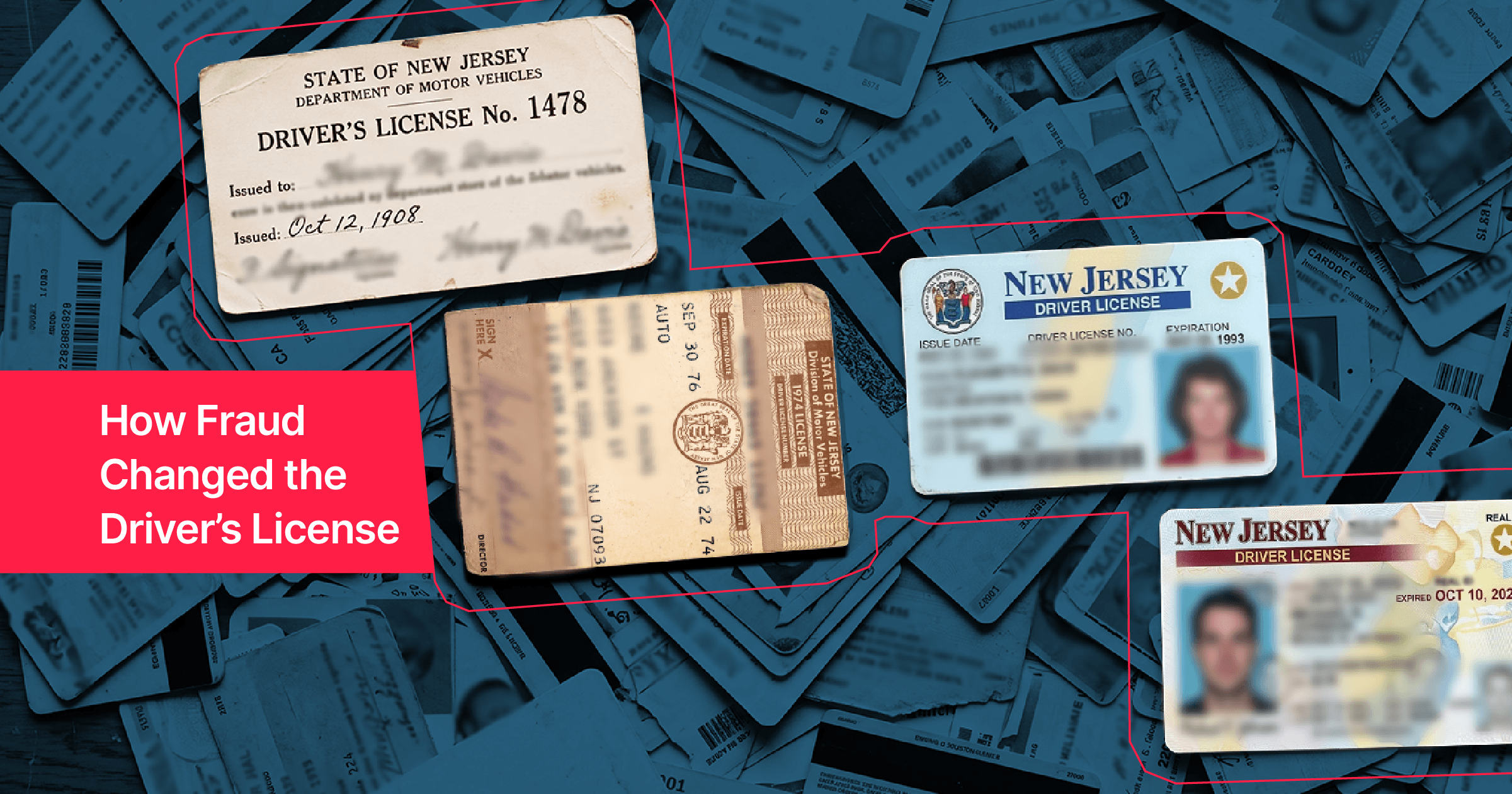
Originally a simple safety permit, the driver’s license became America’s default identity document because it was familiar and ubiquitous.
-
An ID of convenience, the U.S. driver’s license is vulnerable to fraud in ways that few others are, forcing decades of upgrades as technology has evolved.
-
Driver’s License Data Verification (DLDV) is the latest step, letting risk teams check DMV records in real time.
The driver’s license is so familiar that it’s easy to forget how strange it is that a document meant to prove someone could operate a vehicle became the default proof of identity in the United States.
To mark the launch of Driver’s License Data Verification (DLDV) in Intercept, we trace how the driver’s license evolved from a safety permit into the country’s everyday ID, and why the next step is verifying it against the DMV record itself with DLDV.
The chauffeur problem: The driver’s license as safety measure, 1899-1910
The first driver’s licenses emerged in a much different world than the one we know today: cars were rare, expensive, and confusingly high-tech, often operated by chauffeurs rather than their owners. As crashes and hit-and-runs rose, public blame fell heavily on these hired drivers. At one 1909 New York hearing, advocates for an automobile bill argued that “90 per cent of the automobile accidents were due to the carelessness of joy-riding chauffeurs.”
The number was almost certainly rhetoric. But it captured the problem early licensing was built to solve: making sure this new machinery was operated by people who knew what they were doing, and giving authorities a way to trace responsibility when something went wrong. Starting in Chicago in 1899, cities and states began requiring driver’s licenses to make sure early automobiles were operated by qualified, traceable drivers. In New York State, the chauffeur license introduced in 1910 became the first driver’s license to require a photograph.
Suburban strangers: The driver’s license becomes a photo ID, 1958-1986
By midcentury, suburban life meant cars, sprawl, and — less remembered today — the widespread popularity of personal checks. The number of paper checks handled by the Federal Reserve doubled in the 14 years after World War II, to 4 billion, and then doubled again by 1970, to 8 billion. With shoppers driving miles to supermarkets and shopping centers, then paying by check, clerks and tellers needed a simple way to know that the stranger in front of them was really who they claimed to be.
The driver’s license became the convenient solution. Millions of Americans now carried driver’s licenses in their pockets everywhere they went, so retailers and banks began requesting them as ID when accepting or cashing checks. As the license became as much an identity document as a safety credential, states added more identifying information, most notably the photo. California is commonly credited with putting the photo on the front of the modern driver’s license in 1958; by 1986, even the last holdouts, New York and Tennessee, had added mandatory photos for noncommercial drivers.
Fifty states of fake: The driver’s license gets physical security standards, 1976-2008
Making the driver’s license America’s default ID was a gift to counterfeiters: 50 states meant 50 designs, each changing on its own schedule. Front-line ID checkers were expected to spot fakes from places they might never have been. Underage drinking compounded the problem, normalizing fake IDs and creating mass demand for fake-ID makers to get better. By 1976, a federal advisory committee estimated that false ID aided 80% of hard-narcotics smuggling into the U.S., cost businesses about $1 billion a year, and drove government-program losses “into billions of dollars.”
The ensuing decades became an arms race between fake-ID makers and the states: better laminates to stop photo swaps, holograms and special inks to defeat copiers, microprint and UV features that made cards harder to imitate, and eventually PDF417 barcodes that let machines read the license’s data directly. By 2000, the American Association of Motor Vehicle Administrators (AAMVA) had introduced a national card-design standard, and after 9/11, REAL ID turned layered physical security into a federal baseline. States could still issue their own licenses, but the cards now had to be built to resist tampering, counterfeiting, and casual reproduction.
Sources of truth: The driver’s license becomes networked, letting verifiers check the data against the issuing DMV, 2010s - present
States had made the card harder to fake, but the system was still too easy to game. A suspended driver could apply in another state. A fraudster could use a new name. Building on the commercial-driver system created in the 1980s, AAMVA’s State-to-State Verification Service launched in 2015 to help DMVs check whether an applicant already held a license somewhere else. That solved one kind of fragmentation: DMVs could compare records before issuing a new credential.
But as financial services have moved online, the driver’s license took on another job: remote identity verification. Applicants are often asked to upload a photo of their license, leaving analysts to decide whether the image can be trusted. That task is only getting harder in a world of AI-generated documents, deepfakes, and stolen PII. DLDV solves that challenge by letting approved businesses and agencies check license data against the issuing DMV’s own records. As of May 2026, DLDV offered unrestricted DMV checks in 44 jurisdictions.
Real-Time Driver’s License Verification (DLDV)
That is the capability we just added to Intercept: an authoritative, real-time DMV check that’s available within the risk analyst’s existing dashboard. DLDV gives analysts a new source of truth in high-risk reviews, both online and in person. When they suspect the image they’re reviewing may be outdated, doctored, or deep-faked, they can confirm its veracity in seconds. The result is faster decisions, fewer unknowns, and more confidence to approve good customers while stopping fraud.
Learn more about the latest version of Intercept here.
SentiLink Intercept's Driver's License Verification tool, which leverages AAMVA's DLDV for authoritative checks against DMV records at 44 DMVs.